If you are considering PRP for a painful knee, the most useful thing I can give you is not hype — it is an honest timeline, including the part where it feels worse before it feels better.
PRP has been studied more than most regenerative options, and a growing body of research supports the biology behind it. The mechanism is well-established: platelets are a natural reservoir of growth factors — signaling proteins your body already uses to recruit repair cells, build new blood supply, and restore tissue. Concentrating them and delivering them directly to an injured area is a way of amplifying a process your body already runs on its own.
Clinically, the most studied application is knee osteoarthritis. Across multiple randomized controlled trials and systematic reviews, PRP has been associated with meaningful improvement in pain scores and joint function — and in several of these studies, the improvement has been shown to last longer than that seen with a single corticosteroid injection.
Research in tendinopathy — including conditions like tennis elbow and patellar tendinopathy — has similarly supported PRP as a way to support tendon healing, particularly in cases that have plateaued with conservative care. And because PRP is derived from your own blood, it avoids the tissue-weakening effects associated with repeated steroid use.
Taken together, the research supports what the biology suggests: delivering concentrated growth factors to injured tissue can help stimulate the body's own repair process — with results that compare favorably to steroids over the longer term.
None of this means PRP works for every knee or every patient. Response depends on the nature of the injury, the state of the tissue, and the individual — which is why candidacy is always determined through an examination rather than a promise.
If you would like to read the underlying literature directly, a short list of commonly cited studies is included at the end of this article.
PRP is not interchangeable with a cortisone shot — they work in opposite directions. If you have not read it yet, the cortisone comparison explains why that distinction matters so much for the knee.
On the day of treatment, we draw a small amount of your blood and place it in a centrifuge to concentrate the platelets. Preparing the PRP takes longer than the injection itself — the injection is the final step, not the main event.
Some people feel pressure or a brief ache during the injection. Afterward, the knee is typically tender — and that tenderness is expected, because we have intentionally provoked an inflammatory response.
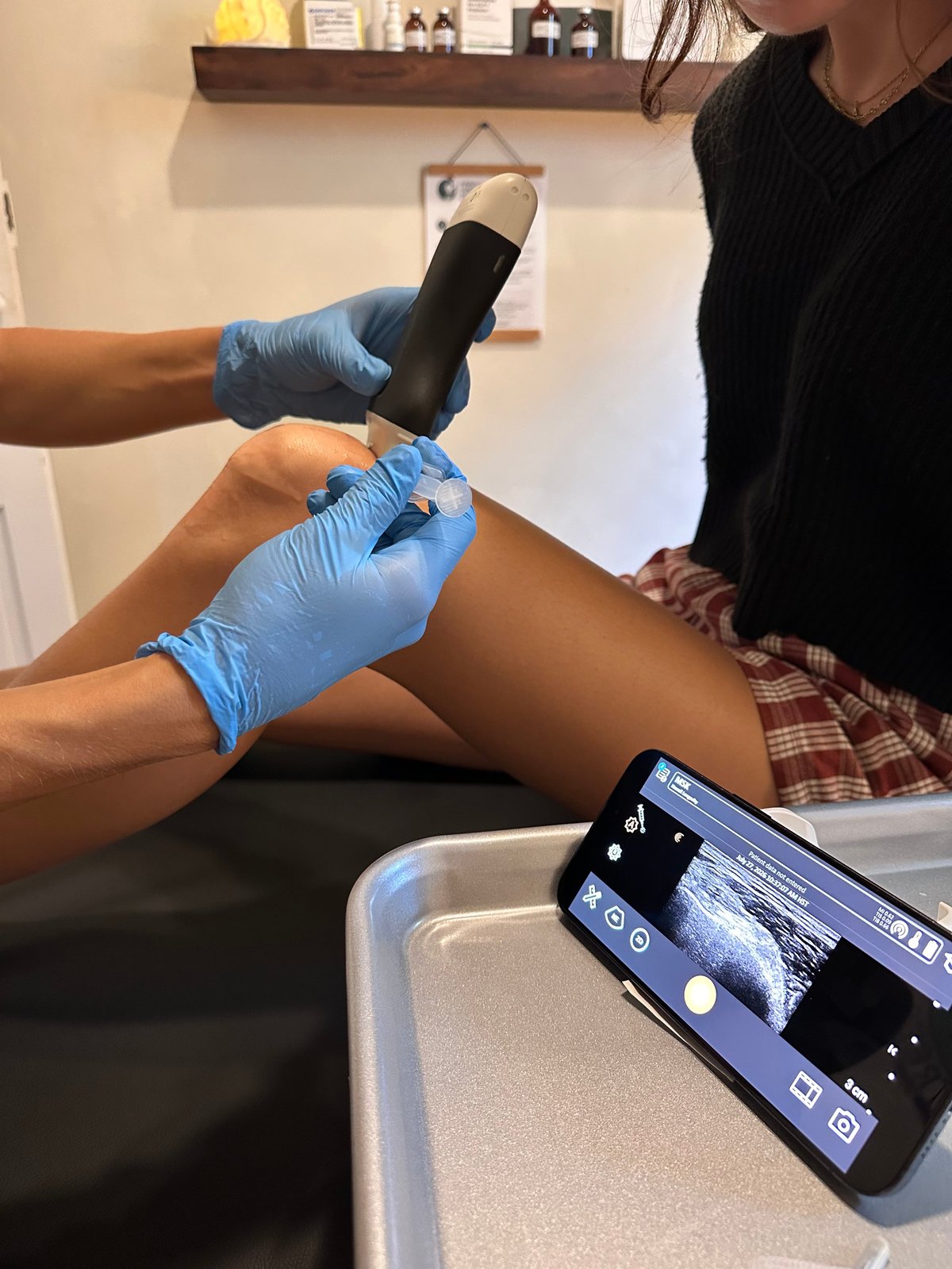
Not every PRP injection is placed the same way. Some are given by feel, using surface landmarks as a guide. Here, injections are ultrasound-guided — and that difference is worth understanding before you have one.
A knee is not simply a joint with a single spot to target. There are tendons, ligaments, bursae, cartilage surfaces, and joint spaces layered within a small area. Where the needle actually needs to go depends on where your problem is — and that is different for every patient.
Ultrasound lets us see where the needle is going in real time — rather than estimating from the outside and hoping it lands where we intended.
The benefits of that are practical, not theoretical:
We can confirm the needle is delivering PRP into the target tissue or joint space — the right destination, not just the right general area.
Being able to see the tissue means we can help steer clear of structures we want to avoid — which matters in a joint this busy.
We can see the actual condition of the tissue as we treat it — the state of a tendon, the fluid in a bursa, the surfaces of the joint.
PRP is a limited resource — a concentrated sample from one draw. Placing it precisely means the treatment is aimed where it belongs.
It is also simply a more honest way to treat a joint. When you can see the structure, you are guided by what is actually there rather than by an assumption. If a presentation turns out to be something different from what was expected, the ultrasound shows it.
There are two timelines running at once: the one you feel (quick and bumpy) and the one happening in the background (slow and quiet).
Day 0–2
Expect soreness, swelling, and some aggravation. The guidance is straightforward: minimize activity that involves the area for the first 48 hours. Give the tissue a chance to begin the process without loading it again right away.
Week 1–2
The provoked inflammation settles and you gradually return to normal activity. This is often the least rewarding stretch — the knee may not feel better yet, and it may still feel irritated.
Around Week 4
This is when many people first notice a real change — less pain, easier movement. It is not a hard guarantee, but the 4-week mark is a common point where the regenerative work starts to become noticeable.
Up to 6 Weeks
The key thing to understand: while you feel better or worse at the surface, the regenerative process itself can take up to 6 weeks to play out. That means patience matters more than day-to-day tracking.
Timelines vary by person and by knee. These are general expectations, not a promise — candidacy and expected course are determined during a consultation.
PRP is most often considered for knees where degeneration or a stalled soft-tissue injury is driving the pain — and where a non-surgical option is desirable. It tends to be a poorer fit where there is significant structural damage that no injection can reasonably address, or where another type of care is clearly more appropriate.
This is precisely why candidacy is determined in a consultation, during an actual examination, rather than over the phone. A knee is not just a knee — the history, the examination findings, and your goals all shape the answer.
The single most important expectation to set is this: the first week is not a report card. If you judge PRP by how you feel on day three, you will likely be discouraged. The process is deliberately slower than a steroid — and that is the point.
If you would like to see how this fits into the bigger picture, the regenerative medicine overview covers our approach, and the PRP for knee pain page walks through the service in detail.
The following are commonly cited studies and reviews in the PRP and regenerative medicine literature. They are provided for further reading and should be reviewed in full to understand their methods and findings.
Reference descriptions are summarized for readability. Full citations can be provided upon request. This content is educational and is not medical advice.
We will examine the knee, review your history, and discuss whether a regenerative approach makes sense — or whether something else is a better fit.
This article is for educational purposes only and is not medical advice. Individual results vary. Services are not intended to diagnose, treat, cure, or prevent disease. A consultation is required to determine the appropriateness of any treatment.